
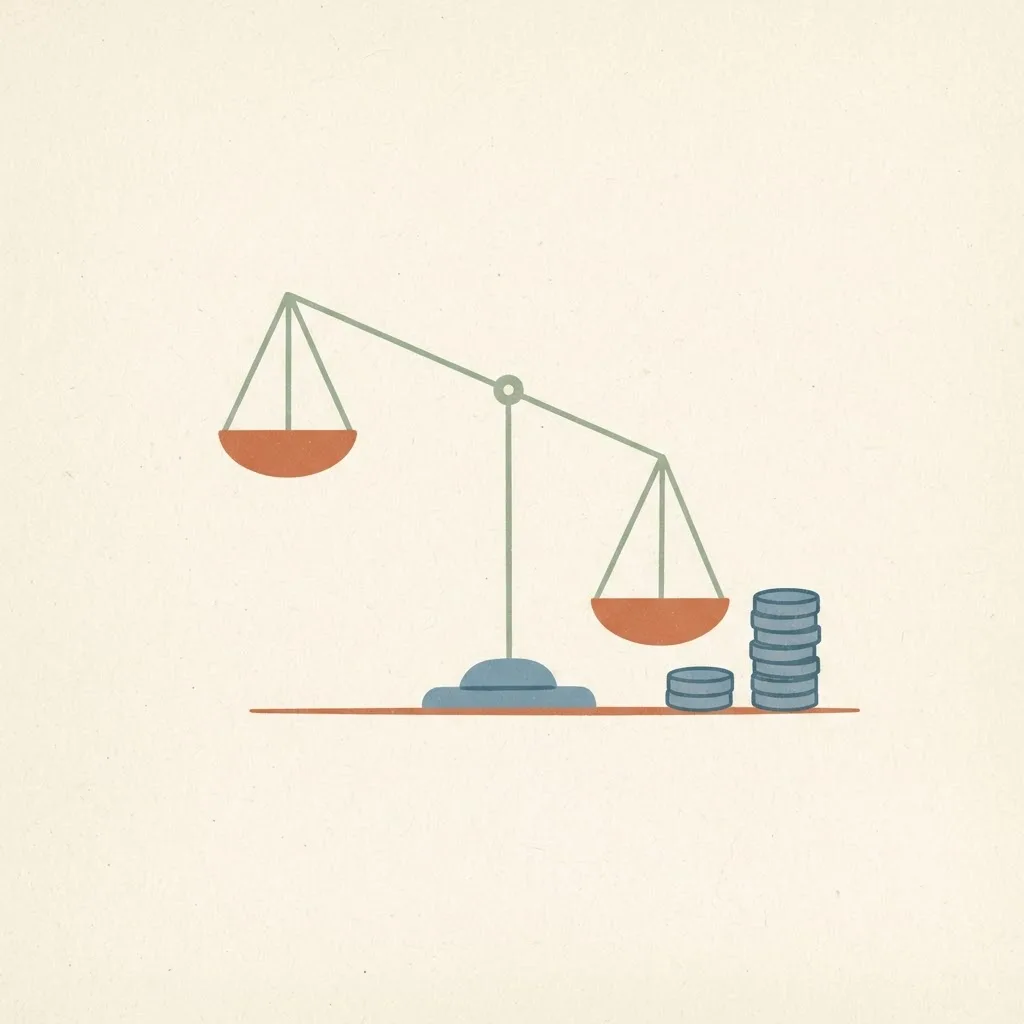
Half of couples argue about money every month, and the ones splitting things "equally" are often the most bitter about it.
Fidelity's 2026 Couples & Money Study found that 58% of partners don't contribute the same amount to shared expenses. Nearly half, 49%, say they avoid the money conversation altogether because it always turns into a fight. Equal splits sound fair on paper. In a household where two paychecks look nothing alike, "equal" quietly means one person is paying a much larger share of what they actually have.
The math that nobody runs
Here's where it gets uncomfortable. Say Maya earns $52,000 a year and Jordan earns $124,000. They split the $2,600 monthly rent fifty-fifty. Maya hands over $1,300, which is about 30% of her take-home pay. Jordan pays the same $1,300, roughly 11% of hers.
So the "fair" split eats three times more of Maya's income. Add utilities, groceries, the streaming bundle, and the occasional dinner out, and she's left with almost nothing to save. Jordan is funding a wedding, a vacation, and a brokerage account.
This is how money resentment actually starts. It grows quietly across a hundred small months where one person feels stretched and the other feels fine.
Have you ever caught yourself checking your account balance before agreeing to dinner, while your partner just says yes?
That asymmetry is the resentment engine. It runs quietly for years.
Why equal feels fair and works out unfair
The instinct behind 50/50 is good. You want things to feel equal, not transactional, not like one partner is being carried. That instinct just doesn't survive contact with unequal paychecks. When the lower earner is spending a third of their income on housing while the higher earner spends a tenth, "equal" becomes the most regressive split in the house.
Proportional splitting fixes the math without making it weird. If Maya earns 29% of the household income and Jordan earns 71%, Maya covers 29% of the rent. That's $754. Jordan covers $1,846. Both are paying the same share of what they actually have. Neither is subsidizing the other. Nobody is being generous, and nobody is being carried.
You can run your own numbers in about thirty seconds at the Halfway fair split calculator.
The data backs it up
Bankrate's 2026 report shows 62% of couples keep at least some accounts separate, and the younger the couple, the more likely they are to do it. A Mercury survey from February 2026 found Gen Z is three times more likely than Boomers to split bills proportionally. The same data surfaces a real fairness gap: 87% of men say their setup feels fair, but only 74% of women agree. That 13-point gap is the sound of one partner quietly carrying the weight.
The fix isn't a breakthrough. It's just running the numbers and letting them guide the split. You keep separate accounts, you keep your independence, and the shared bills get divided by what you each bring in. No spreadsheets, no monthly reconciliations, no guilt.
The conversation you've been avoiding
If reading this made you think of a specific talk you keep postponing, that's the 49% in the Fidelity data. It keeps coming back because the underlying math was never actually settled. Run your numbers, see what proportional looks like for your household, and bring the result to the table instead of the argument. Halfway can track the split for you from there.