

When partners earn different amounts, splitting every shared bill in half can feel simple while leaving one person with much less room to save, spend, or handle surprises. A proportional split gives each person a share of the shared costs that matches their share of the couple's combined take-home pay.
The method is straightforward: agree on which costs are shared, calculate each person's percentage of combined take-home income, then apply those percentages to the shared total. The result is not identical dollar payments. It is a more even share of each person's available income.
Start with take-home income
Use the amount that actually arrives in each person's account after taxes and payroll deductions. Gross salaries can distort the comparison when deductions differ. If someone's income varies, use a recent average over a period that reflects their normal work, then agree when to review it.
Calculate each person's share
Add both monthly take-home incomes. Divide each person's income by the combined total to get their contribution percentage.
For example, say one partner brings home $4,000 a month and the other brings home $6,000. Together they have $10,000 in monthly take-home income. The first partner earns 40% of the total, and the second earns 60%.
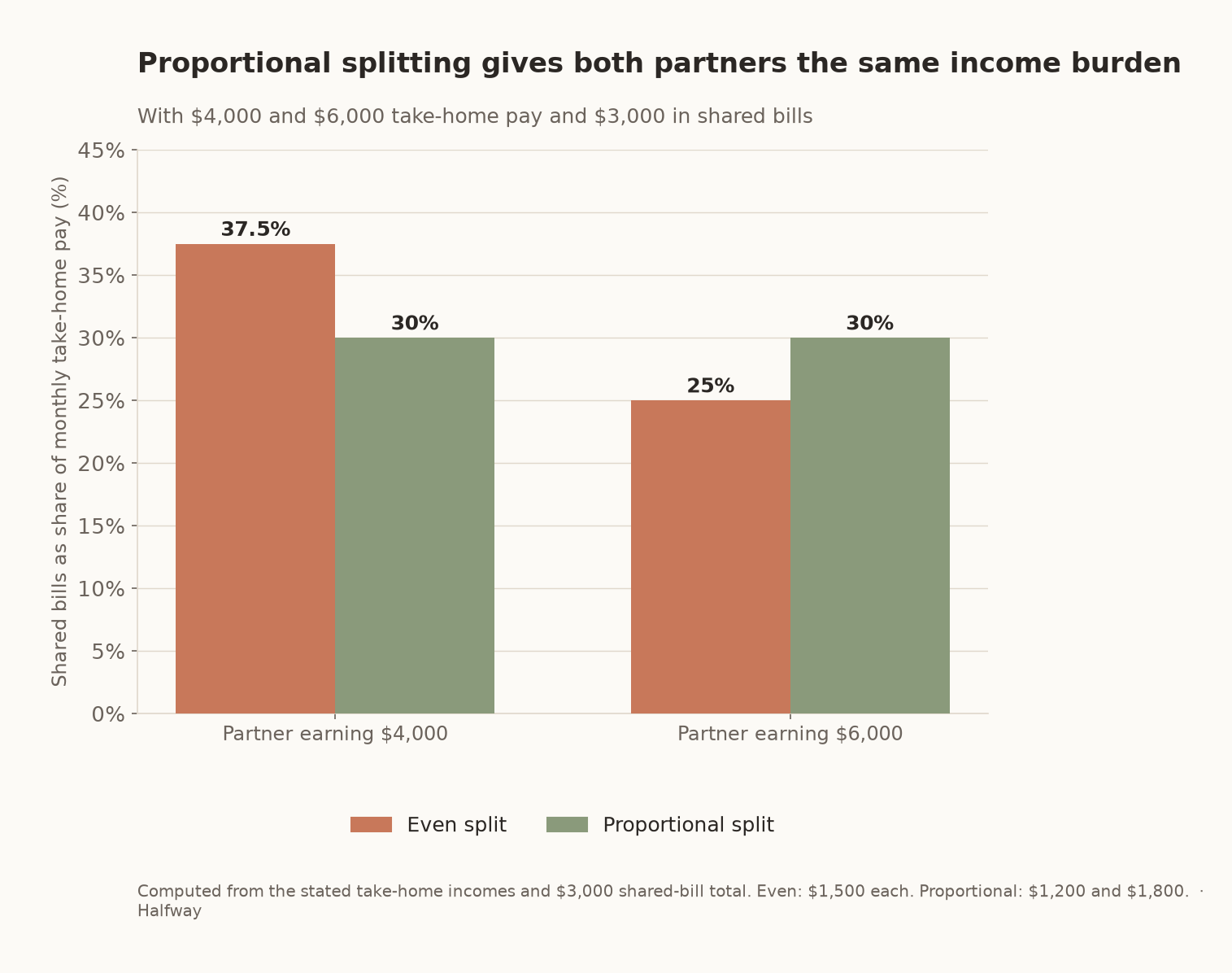
If their shared bills total $3,000, a proportional split assigns $1,200 to the first partner and $1,800 to the second. Each contributes 30% of their own take-home pay. For comparison, an even dollar split asks each person for $1,500. That is 37.5% of the first partner's income and 25% of the second's.
Agree on what counts as shared
There is no universal list. Couples often include housing, utilities, groceries, internet, and subscriptions both people use. They may also choose to include shared transportation, dates, pet care, vacations, or savings goals. Individual debts, hobbies, clothing, and personal subscriptions are often kept separate.
What matters is deciding together before calculating the split. Write down the shared categories, how you will handle occasional expenses, and whether savings contributions belong in the shared budget. A shared budget can help make those decisions visible.
Choose a way to handle payments
Some couples keep their personal accounts and each transfer the agreed amount into a joint account for bills. Others divide bills by category, checking that the totals still match their percentages. A third option is for one person to pay and the other to reimburse their share on a set schedule.
A joint account is not required. The split is a way to allocate shared costs, not a rule that says all money must be combined. If you are deciding how much to combine, the joint, separate, or hybrid quiz can help you talk through the setup.
Make the arrangement work for both people
Does the percentage feel fair in practice, not just on a spreadsheet? Talk about it before changing transfers. The lower earner may be worried about having enough left for personal needs. The higher earner may want clarity about what counts as shared and whether the arrangement changes as incomes change. Both concerns belong in the conversation.
Look at the same numbers together: each person's take-home pay, the agreed shared expenses, their contribution, and what remains. A proportional split does not mean one partner gets to approve the other's personal spending. It creates a clear agreement about shared costs while leaving personal money under each person's control.
For variable pay, decide in advance whether to use a rolling average, a base salary, or another consistent measure. Revisit the numbers after a lasting income change, a new shared expense, or a change in work hours. A regular check-in is easier than trying to settle the rules during a stressful bill payment.
Use the formula
Each person's share = their take-home income ÷ combined take-home income × shared expenses.
In the example, $4,000 ÷ $10,000 × $3,000 = $1,200. The other partner's share is $6,000 ÷ $10,000 × $3,000 = $1,800. You can enter your own figures in the income split calculator to see the amounts side by side.
A fair system is one both people understand, can revisit, and can live with month after month.