
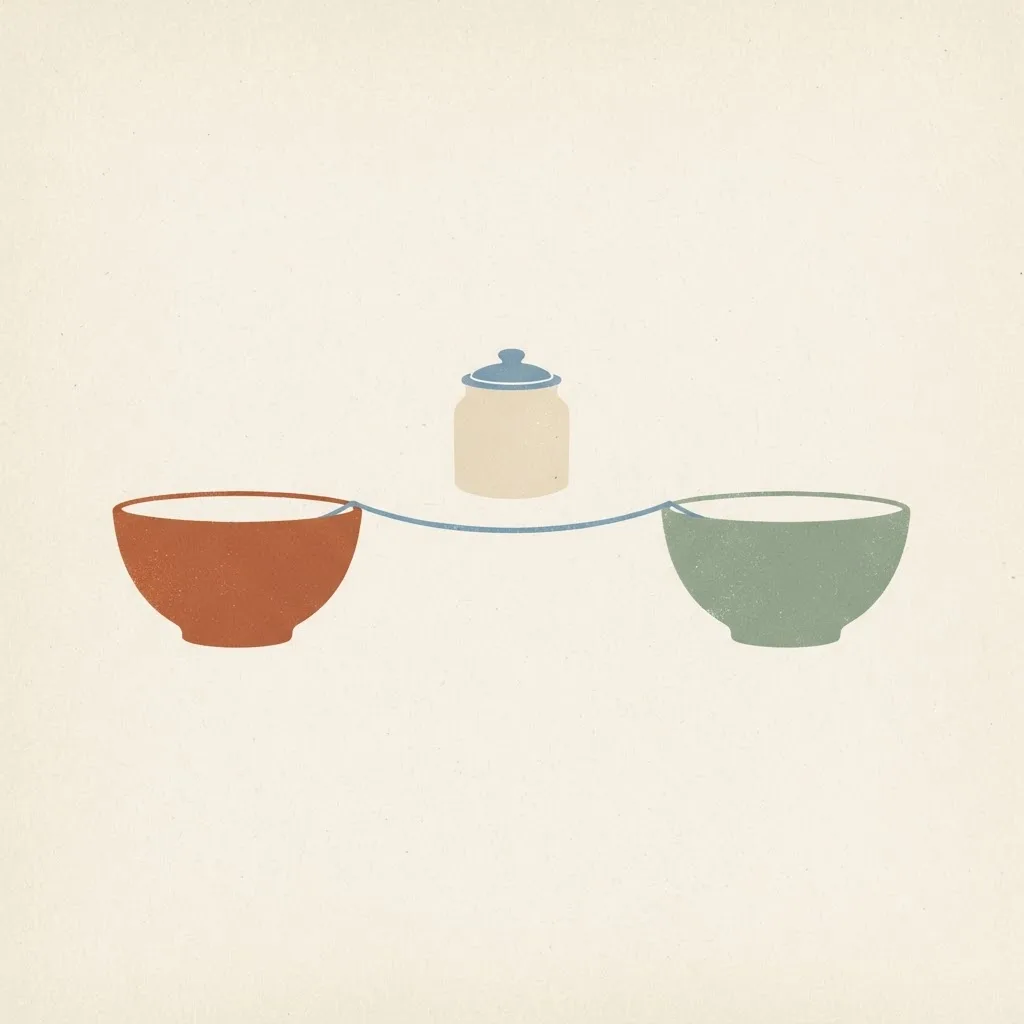
The “Yours, Mine & Ours” setup is simple: each partner keeps a personal account, and you both contribute to one shared account for shared costs. The structure gives you a common plan without turning every personal purchase into a group decision.
The part that usually causes friction is not opening the accounts. It is deciding how much each person should put into the joint account every month. A 50/50 transfer is easy to automate, but it is not automatically fair when your incomes are different.
What “Yours, Mine & Ours” actually means
Think of the system as three clear buckets:
- One personal account: money one partner controls individually.
- The other personal account: the same privacy and flexibility for the other partner.
- Joint: one shared account for costs and goals you have agreed are shared.
Halfway uses All, Shared, and Personal filters in the app, but the principle is the same. Shared costs might include housing, utilities, groceries, subscriptions you both use, pet expenses, and a joint emergency fund. Personal spending can stay personal without either partner having to justify every coffee, gift, or hobby purchase.
How much should go into the joint account?
Start with the total monthly amount the shared account needs, then decide how each partner contributes. There are three common approaches:
- Equal dollars: each person transfers the same amount.
- Proportional to income: each person covers the same percentage of their income.
- A custom agreement: one partner contributes more because of a temporary situation, unpaid care work, debt, or another factor you both agree matters.
For couples with unequal incomes, proportional contributions are often the cleanest starting point. Fair does not always mean equal dollars. It can mean the shared cost takes the same relative bite from both budgets.
A real example of funding the joint account
Imagine your shared monthly costs total $3,000. Partner A earns $4,000 per month and Partner B earns $6,000. Together, you bring in $10,000, so the income shares are 40% and 60%.
With a proportional plan, Partner A contributes $1,200 and Partner B contributes $1,800. The joint account receives the full $3,000, and each partner contributes 30% of their gross monthly income.
With a 50/50 plan, each person contributes $1,500. That is 37.5% of Partner A’s income and 25% of Partner B’s. The transfer is equal, but the impact is not.
Want to test your own numbers? Use the Halfway fair split calculator to work out the income-based share before you set up automatic transfers.
How to reduce contributions without changing the split
If your shared-account budget changes, keep the same contribution ratio by applying each partner’s percentage to the new total. You do not need to renegotiate the method every time one bill goes up or down.
Say you currently contribute $1,400 and $2,200, for a total of $3,600. The first contribution is 38.9% of that total (1,400 ÷ 3,600); the second is 61.1% (2,200 ÷ 3,600). If you need to bring the combined transfer down to $2,600, multiply the new total by those same shares: about $1,011 for the first partner and $1,589 for the second. Together they still add up to $2,600.
That keeps the existing arrangement in proportion. If your incomes change, calculate the ratio again from your current incomes, then apply it to the shared-cost total. A cost change calls for scaling the same ratio; an income change may call for a new ratio.
Should contributions be based on gross or take-home pay?
There is no universal answer. Take-home pay can feel more practical because it reflects the money that actually reaches your accounts. Gross income can be simpler if your deductions are very different or change often. Pick one method, use it consistently, and revisit it when income or household costs change.
If one person has irregular income, use a realistic average from the last few months and keep a small buffer in the joint account. You can also set a minimum monthly transfer and true up the difference when a bonus, commission, or freelance payment arrives.
What belongs in the joint account?
Make the list before choosing the transfer amount. Include recurring bills, shared variable spending, and shared goals:
- Housing, utilities, insurance, and groceries
- Shared subscriptions, transportation, and pet costs
- Emergency savings, travel, or a future home fund
Then add a buffer for the costs you forget the first time. If your shared expenses average $3,000, transferring exactly $3,000 can leave you short after an annual bill or an expensive grocery month. A modest cushion is easier than repeatedly asking who should cover the gap.
How to set up the system without making it complicated
- List every expense you both consider shared.
- Separate monthly costs from annual or irregular costs.
- Choose your contribution rule and write it down.
- Open or designate the joint account for shared money only.
- Schedule automatic transfers after each payday.
- Review the numbers once a month for the first three months.
Use a shared account for shared obligations, not as a test of commitment. Some couples combine nearly everything. Others keep most money separate. The right structure is the one that makes responsibilities visible and leaves both people with reasonable control over personal money.
What about expenses that feel half shared?
Agree on a rule for gray areas before they become arguments. A date night, a gift for a mutual friend, or a weekend trip may be shared for one couple and personal for another. You can set a dollar threshold, create a separate fun category in the joint account, or decide that whoever suggests the expense pays for it personally.
The goal is not to create a perfect taxonomy for every transaction. It is to remove the recurring decisions that drain your relationship. Once the rule works, stop renegotiating it at the checkout counter.
When should you change the contribution amount?
Review the joint transfer when rent changes, a new debt appears, one person changes jobs, income becomes irregular, or your shared goals change. A quick quarterly review is usually enough. If one partner is doing unpaid caregiving or taking a temporary income cut, the old percentage may no longer reflect what feels fair.
You can also use the joint or separate accounts quiz if you are still deciding whether a hybrid setup fits your relationship.
The simple rule
Keep personal money personal, put agreed shared costs in the joint account, and contribute in a way that respects both budgets. For many couples with different incomes, that means proportional transfers rather than an automatic 50/50 split.
Once the rule is clear, the joint account can do its job: cover shared plans while each person keeps room to manage personal money.